Skip to content

The discount is not the deal.

A carrier proposal makes its best terms easy to see. The real decision is what the complete offer does to the packages you actually ship—and whether the next revision or carrier can be reviewed without starting over.

ParcelAdvisor calculates the package economics first, connects the wider commercial context second, and keeps every carrier, offer, and revision in one shared decision context.

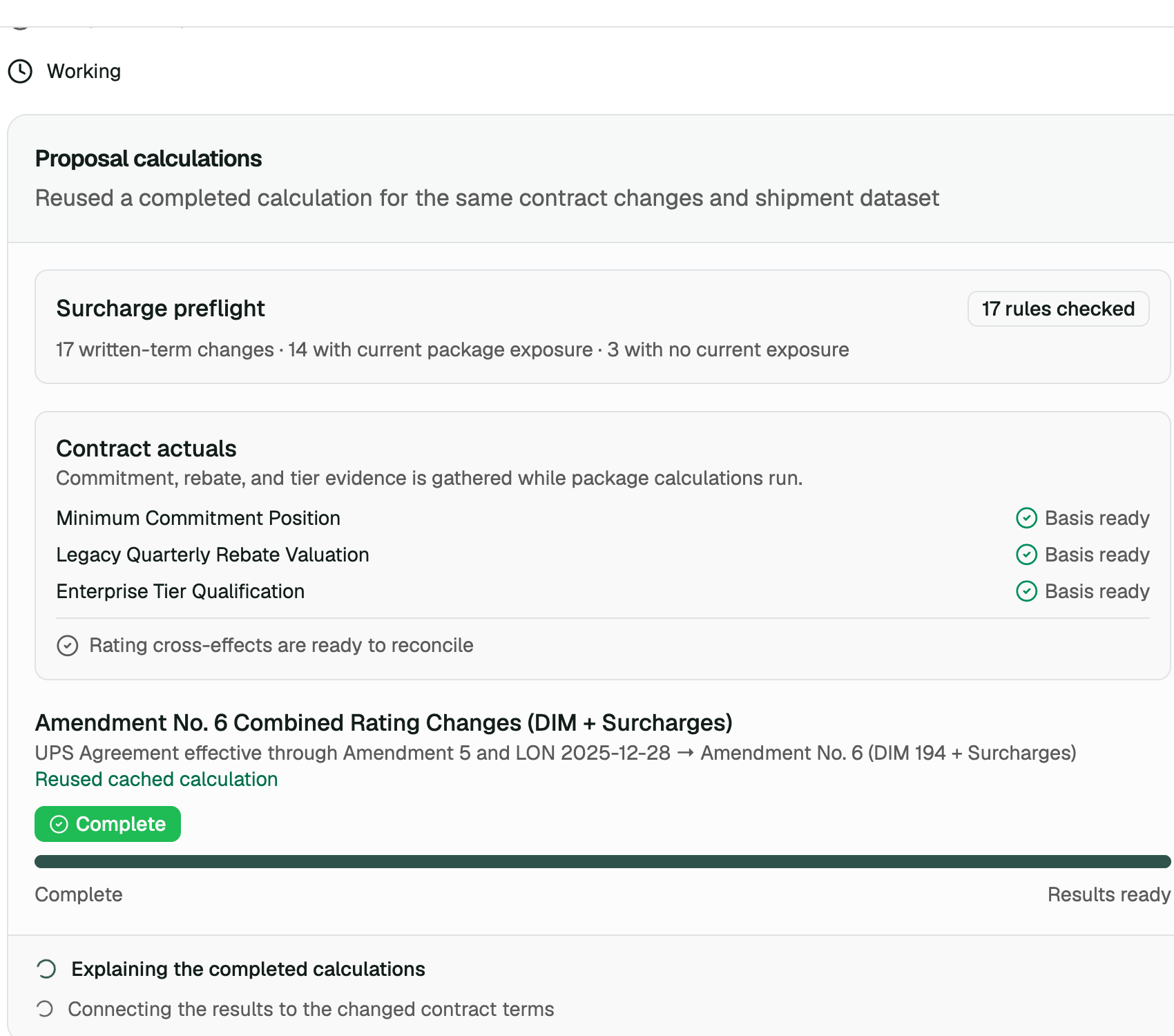
Sanitized ParcelAdvisor proposal analysis showing written-term checks, package exposure, contract actuals, and completed rating changes
Captured productProposal calculations in ParcelAdvisorSanitized · Private Preview

The carrier presents improvements term by term. Your economics interact.

Better package rates, dimensional treatment, or surcharge discounts may all be real. Their value can still be reduced by a removed rebate, a harder qualification gate, a different tier basis, minimum charges, commitments, or agreement term.

Do not let the carrier's presentation become the buyer's analysis.
Visible improvement
Package pricing
Offset
Existing rebate removed
Qualification risk
Tier basis unresolved
Decision
Reconcile the whole offer

Calculate first. Then let Advisor connect the deal.

Hold the reviewed agreement and one defined shipment dataset constant. ParcelAdvisor's deterministic engine rerates every eligible package under the governing agreement and proposed contract, with coverage, exclusions, and unrated items retained beside the result.

Advisor then connects those package-level calculations to rebates, tiers, qualification gates, minimums, surcharges, commitments, term, and written evidence.

  1. 1
    Fix the basis

    One reviewed agreement state and one defined shipment dataset.

  2. 2
    Rerate package by package

    Every eligible package is calculated under both sets of terms.

  3. 3
    Reconcile the whole offer

    Advisor connects the deterministic result to the commercial conditions and evidence.

The calculated result comes from the rating engine—not a language-model estimate.

Supporting capabilities: Proposal Analysis · Contract Intelligence · ParcelAdvisor

The answer the headline leaves out.

A package-rate improvement becomes a decision only after the offsets, qualification requirements, coverage, and next written question are visible beside it.

Economic summary · Proposal V1Current agreement versus proposal · illustrative annualized values
Calculation complete

Swipe sideways to inspect every column.

Illustrative whole-offer economic summary
Economic leverChangeAnnual impactDecision meaning
Package-rate improvementImproved+$610KReal value across the eligible packages in the defined dataset.
Current quarterly rebateRemoved−$183KGives back part of the package-rate improvement.
Enterprise tier basisStill openNot quantifiedThe qualification basis needs a written answer.
Net calculated annual valueConditional+$427K · 4.48%Favorable before the unresolved tier-basis risk.
Advisor conclusion

The package economics are favorable. The commercial structure still needs revision.

Keep the package-rate improvement. Restore the rebate value. Put the tier basis in writing.

Illustrative product statePackage rerate → whole-offer conclusionSynthetic, illustrative values · Private Preview
The decision is more than the net number.

It includes the conditions required to earn the value, the risk still outside the calculation, and the next written request to the carrier.

The next offer should not restart the work.

When a revision—or another carrier—arrives, the governing agreement, shipment basis, prior sources, findings, and open questions remain in context. The buyer can see what changed, what held, and what still needs an answer without rebuilding the decision from scratch.

Multiple bids and revisions are available today in shared Advisor context. Pairwise calculations retain their stated baseline, scope, and coverage. Governed cross-bid what-if mapping is near-term and is not shown here.

Carrier bid reviewMultiple carriers · multiple written rounds · one reviewed context
Context ready
Agreement in force Defined shipment set Carrier A · V1 Carrier A · V2 Carrier B · V1
Carrier A proposal · V2.docxWhat actually changed from the first offer?
Activity3 representative steps
  1. Compared the revision with Carrier A V1.
  2. Retained the verified package calculation and reviewed only changed terms.
  3. Reconciled the restored rebate with the remaining qualification question.
Advisor answer

The carrier fixed the rebate issue. The tier basis still needs an answer.

The revision stays in the same decision context. Advisor separates what changed, retains what held, and keeps the remaining risk visible for the next round.

Package pricingPrior package calculation retained
Unchanged
Quarterly rebateThe principal offset is resolved
Restored
Tier qualificationWritten basis remains ambiguous
Still open
DecisionOne material question remains
Improved

Get the tier basis in writing before treating the revised economics as the final deal.

Illustrative product walkthroughCarrier A V1 → Carrier A V2 → Carrier B V1Synthetic demo data · Context current · Calculation flow Private Preview

More bids and more rounds become practical while the leverage is live.

From an acceptable full new carrier contract drop through structuring and human review to analysis-ready typically takes about one to two hours, depending on source quality, complexity, and scope. This is an operating expectation, not a guaranteed SLA.

A lean team can evaluate more competition and keep written rounds moving without sacrificing the reviewed economic basis.

Human-reviewed before analysis-ready

Know what the whole offer is worth before you answer the carrier.

Bring the proposal already in front of you. See what holds up, what offsets it, and what to ask for next—then keep the same context when the revision or another carrier arrives.